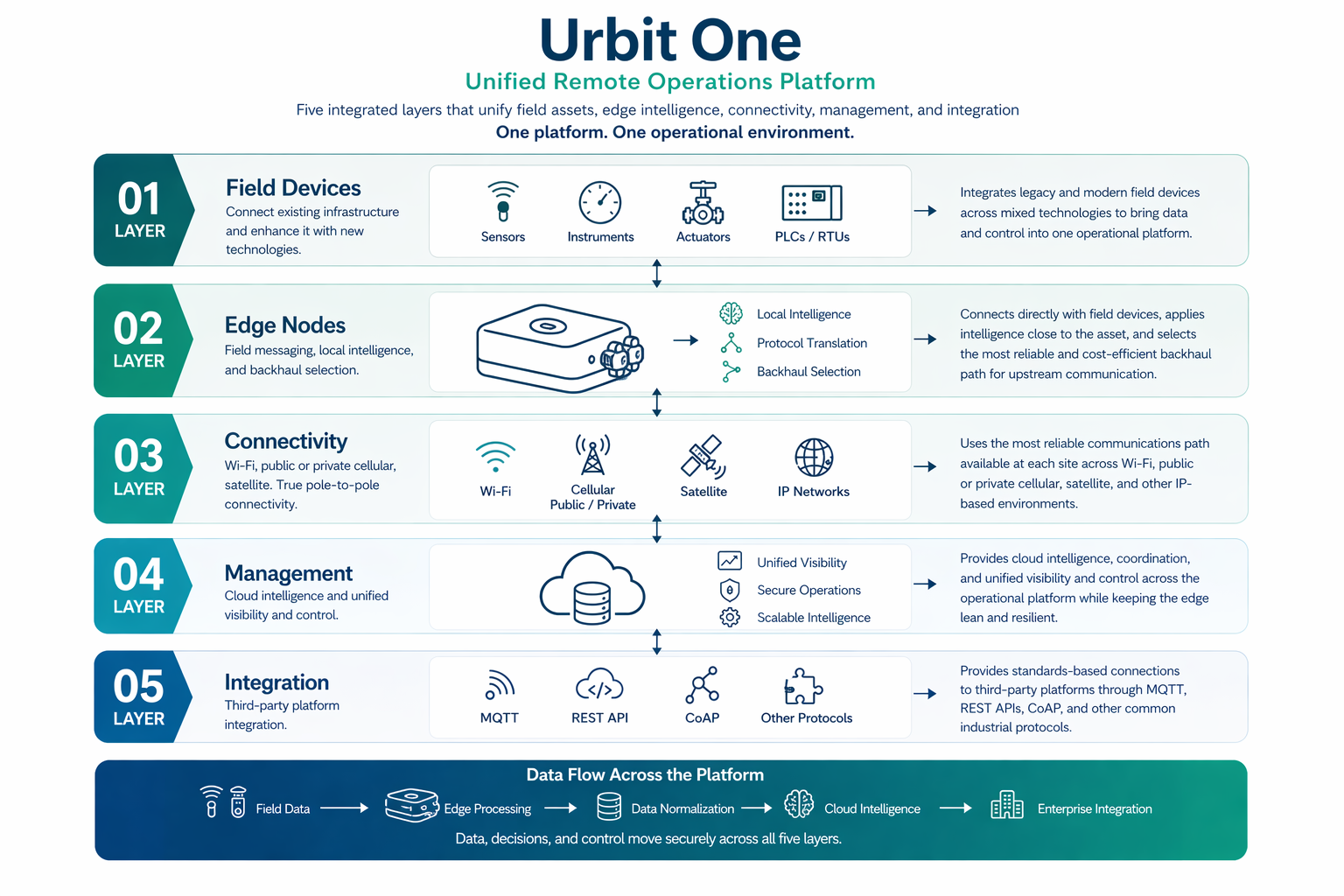
Addressing the Challenges of Remote Supervision of Isolated Hazardous Assets
(e.g., Pump Stations, Metering Stations, Compressor Stations)
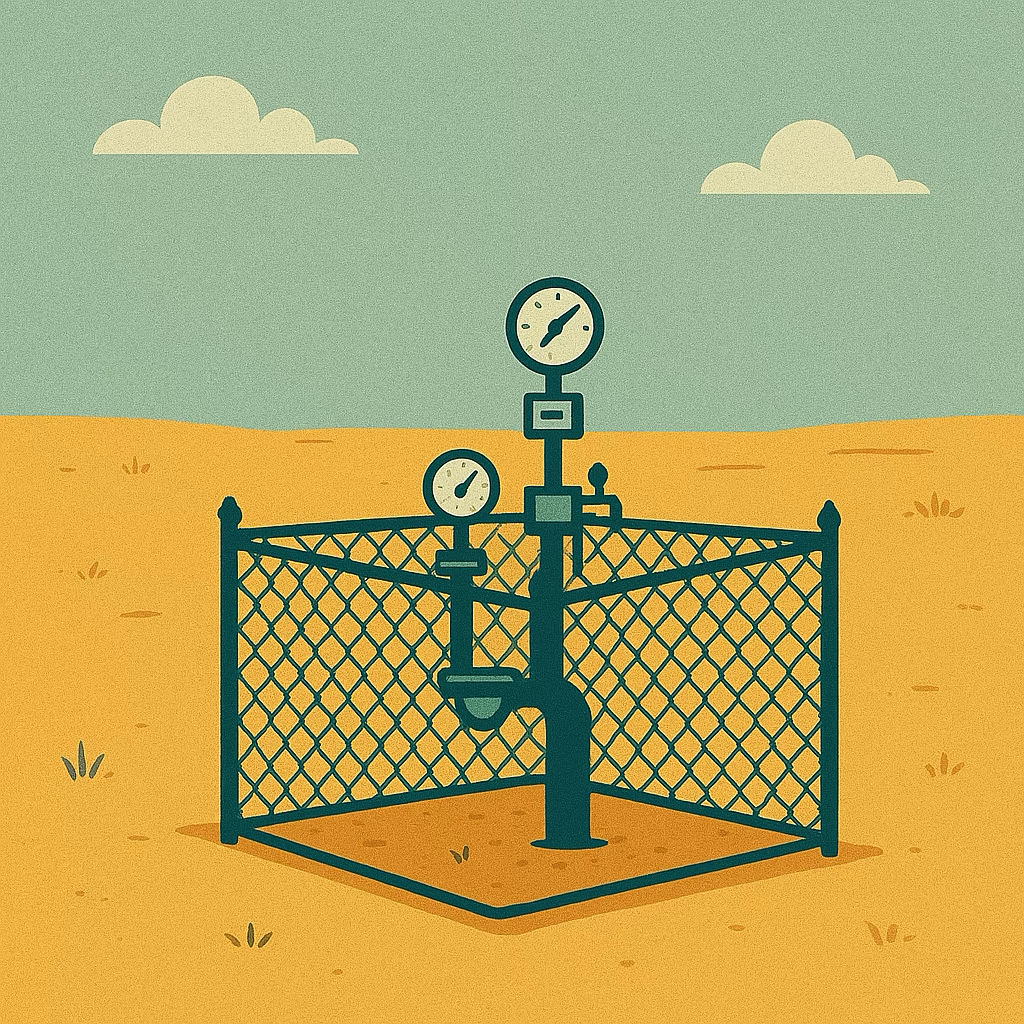
Why connect an autonomous asset?
Remote assets often operate reliably without continuous supervision. However, connecting these previously offline systems to a monitoring center can significantly enhance situational awareness, reduce the need for site visits, and enable timely remote intervention.
The key question is whether the cost of connectivity justifies these benefits. The answer depends on the specific case. This document’s goal is to present a cost-effective alternative to conventional network deployments, offering a viable path for modernizing assets that have remained offline. By being aware of this possibility, readers may reconsider the modernization of a location or assert that remained offline because deploying a network is not feasible, despite occasional operational challenges.
Limitations of conventional connectivity.
Deploying a fiber optic network involves considerable upfront costs, planning, permitting, civil works, materials, regulatory compliance, and ongoing operation and maintenance expenses. In many cases, the available bandwidth is underutilized, unless other services like CCTV are implemented. While cost-sharing with third parties may appear attractive, it introduces cybersecurity risks and depends on the availability of interested partners, which is not always guaranteed.
Additionally, upgrading instrumentation in legacy facilities can be complex, particularly when the entire site is classified as a hazardous area (typically Zone 1 or Zone 2), imposing strict compliance requirements.
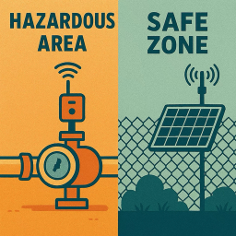
A solution for the aforementioned case involves utilizing intrinsically safe radio transmitters within the hazardous area and installing a receiver with cellular or satellite connectivity outside the hazardous area, where it is safe.
This is where LoRaWAN emerges as a potential solution.
LoRaWAN (Long Range Wide Area Network) is a low-power, long-range wireless protocol designed for battery-operated devices in distributed environments. It is widely used in industrial IoT applications such as utilities, infrastructure monitoring, and agriculture.
Key benefits:
- Long-range communication (up to ~5 km line-of-sight, depending on environment)
- Ultra-low power consumption (multi-year battery life)
- Bidirectional secure communication using end-to-end AES-128 encryption
- Optimized for small, periodic data exchange
System components
End-device: LoRaWAN transmitters connected to field instruments, or integrated sensing units, actuators and control interfaces.
Gateway: A LoRaWAN gateway serves as a bridge between LoRaWAN end-devices and the LoRaWAN network server. It receives LoRa radio messages from the end-devices and forwards them to the backend network and application servers.
In the case of far isolated assets, it may be challenging to find a suitable location for the Gateway with cellular coverage and mains power within a 5-kilometer range. To address this, a solar panel-powered LoRaWAN Gateway with a satellite network backhaul can be installed on the fence post. Alternatively, LoRaWAN repeaters can be used until the first location with cellular coverage and mains power.
If your organization operates isolated assets where lack of connectivity is creating operational inefficiencies or risk exposure, modern wireless architectures provide a compelling alternative to traditional infrastructure-heavy solutions.
Contact us to explore the possibilities.
info @urbit.us
www.urbit.us